Bits of Hope at COP30
Meet the Yacumama flotilla — Indigenous peoples and Amazonian youth who navigated the Amazon to COP30, placing Indigenous voices at the centre of climate conversation.
Bits of Hope at COP30
As we look ahead to International Women’s Day next month, we want to highlight the vital role women play in climate action. One way we’re doing so over the coming weeks is by sharing the experiences of three climate activists and land defenders who attended COP30, held in Belém, Brazil late last year.
COP — the Conference of the Parties — is the annual gathering of countries that are signatories to the United Nations Framework Convention on Climate Change (UNFCCC). It is often described as the most important global space for climate negotiations.
The women featured in this series are also participants in the Amos Climate Fellowship, an Amos Trust programme that supports young women land defenders and climate activists from Mexico and Central America in designing and implementing climate action projects rooted in their territories and grounded in a gender perspective.
Amid the often discouraging narratives that surround these negotiations, we want to make space for other voices — voices grounded in territory, resistance and hope. This is why we have titled this blog series “Bits of Hope at COP30”.
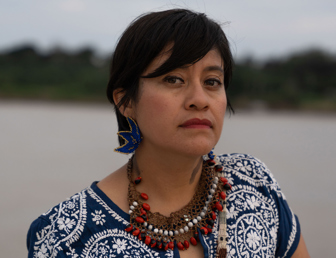
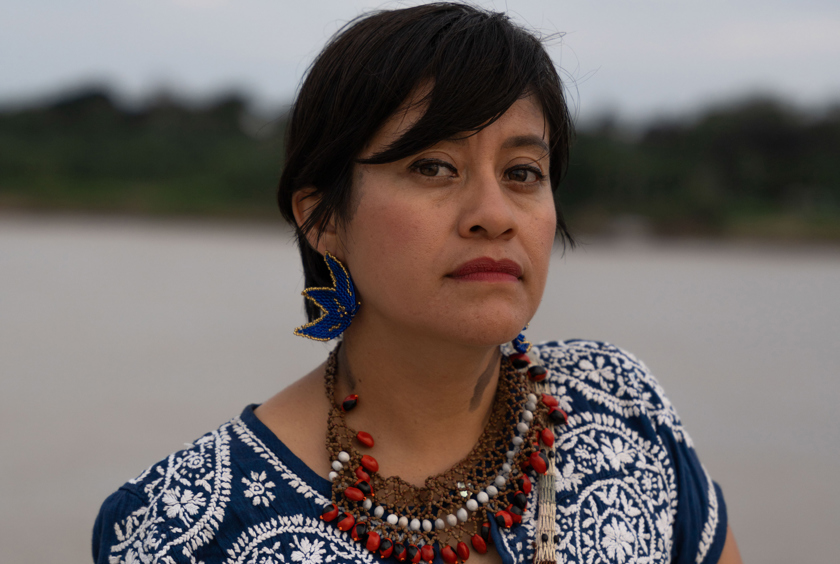
In this first instalment, we spoke with Lucía Ixchiu, a participant from the first cohort of the Climate Fellowship. She is a Maya K’iche’ woman, a member of Festivales Solidarios in Guatemala and part of the organising and communications team of the Amazonian flotilla Yacumama.
The Yacumama flotilla: A collective dream
The Yacumama flotilla — “Mother Water” in Kichwa language — is a collective project of Indigenous peoples and Amazonian youth that navigated the rivers of the Amazon from Ecuador to Brazil, with the following objectives:
- Self-representation of Indigenous voices: “We have believed all our lives that we can tell our own story, that we can make ourselves visible, that we can speak.”
- To foster learning dialogues in the territories.
- To learn about alternatives to climate destruction that Indigenous peoples have maintained ancestrally and now implement using local technologies.
The flotilla — a delegation of 60 people composed of youth, queer communities and elders — began its journey on 8 October at the Cayambé glacier in Ecuador, where the Napo River, a tributary of the Amazon, originates.
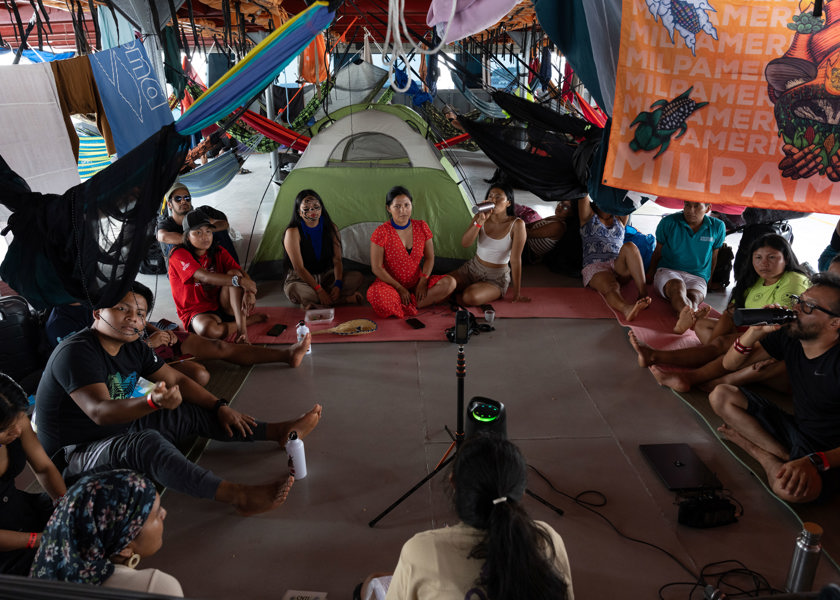
Inside of the flotilla: A delegation of 60 people composed of youth, queer communities, and elders
“We first went to do what must be done, which is to ask for permission. We asked Grandmother Cayambé — the glacier — for permission, as the Kichwa peoples of the Andes in Ecuador call and honour it.”
From there, the flotilla navigated through the Ecuadorian Amazon, passing through places such as Iquitos in Peru, the tri-border area and Leticia, before reaching Tabatinga and Manaus in Brazil. For the flotilla, it was essential to travel through the territories before the COP, because for Lucía, “the COP is in the territories, not at the United Nations, not in the negotiations, nor in the companies that do not listen, or where our voice does not even have the legitimate participation it should.”
During the journey, they exchanged experiences with communities using drones to monitor illegal logging, communities that defend the forests against fires — such as the river Pataxó brigades in Santarém, Brazil — and met the people behind the floating film festival in Iquitos.
“Despite the destruction caused by fossil fuels across the Amazon, and seeing the extraction sites in the middle of the jungle, we could observe people who are striving to build other ways of life, and for us, that was extremely hopeful.”
Why a flotilla?
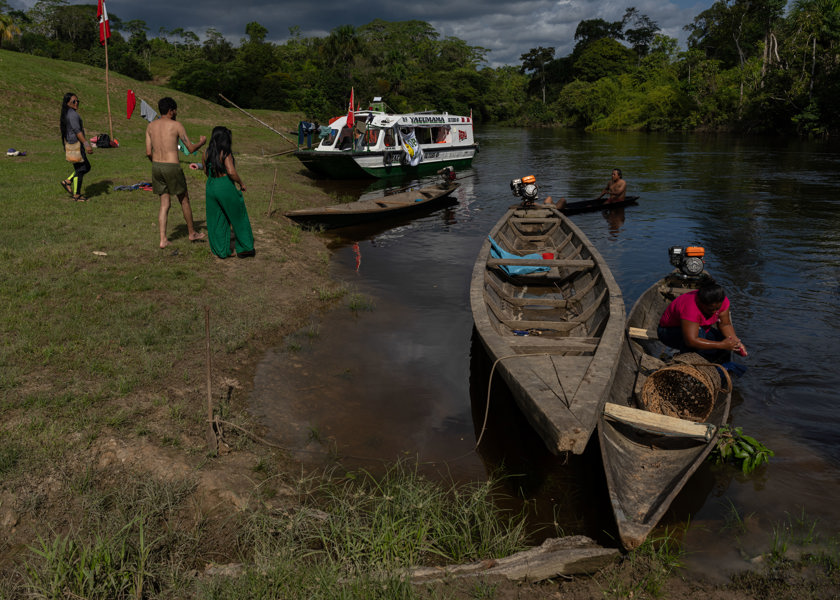
The Yacumama flotilla navigating the Amazon
At first, Yacumama was going to be called a caravan. However, unlike other mobilisations travelling by land to the COP, this group was moving along the river.
“Why are you calling yourselves a caravan if you’re travelling by boat?” asked a female ancestor from Indonesia who also joined the journey. “So we said: we are a flotilla.”
While the Yacumama flotilla was collectively co-creating its name and identity, the world was witnessing humanitarian flotillas attempting to break the illegal blockade on Gaza. Choosing to call themselves a flotilla therefore also became a political act — a way of expressing solidarity with those humanitarian missions.
“It was an intense debate within our organisation. For me, it was important — and political — to say that we are a flotilla.”
During COP30, the Yacumama flotilla also had the opportunity to meet with the Sumud Flotilla. In that conversation, its members shared that after being released from the prison where they had been held by Israel, they had seen the news about Yacumama. They had not planned to attend the COP, but they changed their minds.
“They decided to go because Yacumama was also an inspiration to them. They said it publicly during a meeting. For us, that meant a great deal.”
Arrival in Belém
“When we arrived in Belém, we were the sensation.”
The purpose of this journey was to place Indigenous voices at the centre of the climate conversation — and they succeeded. Yacumama was welcomed by the press and had the opportunity to take part in numerous information sessions and closing events related to the experience. Exchanges were held in various spaces, such as Casa Maracá and different pavilions in the Blue Zone.
Many young Indigenous people, aged 18 to 25, had the opportunity to share the story from their own perspective and narratives, recognising themselves as those who continue the struggles of their ancestors.
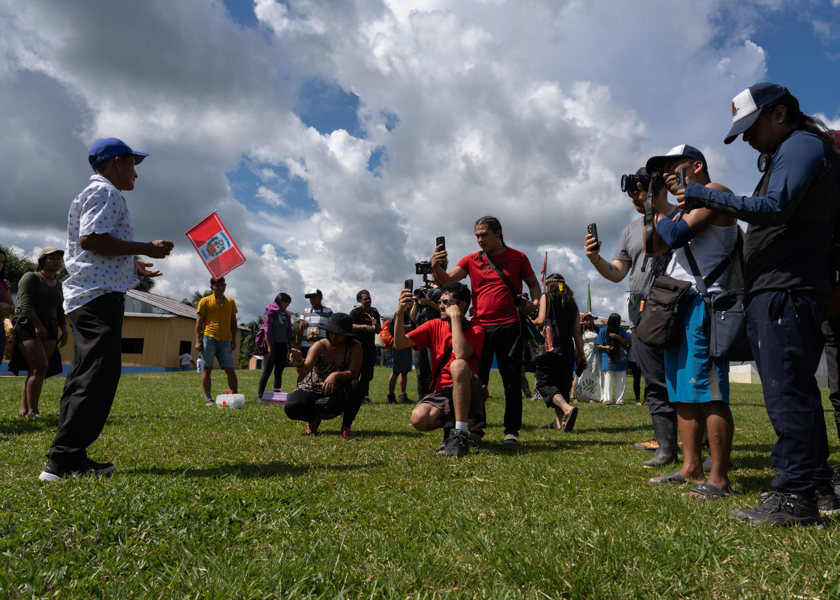
A young Indigenous men sharing his story
Yacumama participated in several mobilisation events, including the Global Climate March — attended by 70,000 people, which Lucía describes as a historic mobilisation denouncing environmental crimes. They were also present at the Global Indigenous March, convened by the Alliance of Indigenous Peoples, and at the Funeral for Fossil Fuels.
Why continue participating in the COP?
“I am not here to lobby for any extractive company. I am here to denounce them.”
When asked why it’s important to continue attending the COP, despite it being a space that often excludes Indigenous communities, Lucía told us:
“I have found it quite paternalistic, even racist, that people question why we participate, belittling us and trying to supervise us. We are fully aware of everything that happens at the COP. However, we are not going to stop participating, because otherwise others speak on our behalf.”
As in many regions of the Global South — especially in Latin America — Lucía recognises that all United Nations spaces are territories in permanent dispute, where it has historically been almost impossible for Indigenous peoples, Indigenous women and queer communities to attend.
“We are there defending our existence, because the future of our territories is at stake. How could we not participate? Even if they are racist, even if they are exclusionary, we will continue making them uncomfortable.”
This year, one member of Yacumama was able to participate in the negotiations. Lucía hopes that in future years there will be more, because Indigenous communities can no longer allow others to speak on behalf of corporations or territories.
“Why is the chief of the Pataxó river community not the one speaking in this mechanism, and instead someone from an international organisation?”
Lucía emphasises that much remains to be done — continued training in negotiations and Indigenous diplomacy is essential.
For the next COP, which will take place in Turkey, Yacumama plans to carry out a denunciation tour across Europe, recognising that most of the companies destroying their territories are European. They then plan to travel to Turkey to create spaces for exchange and diplomacy, hoping that more Yacumama members can take part in the negotiations.
What inspires you to continue this path?
This was the final question I asked Lucía.
“On this journey I discovered that the land I come from travelled with me,” said Lucía — who has a history of exile from her home country, Guatemala. “The land is not necessarily the physical place where we are. Being with Yacumama is creating those territories in movement.”
Lucía shared that a fundamental element of this journey was recognising that this route had been travelled before by her ancestors. Retracing it was a way to continue the work they had started. As a filmmaker and communicator, Lucía highlighted that communication is the art of serving, and accompanying others as they tell their own stories was one of the most beautiful experiences she has had.
Finally, Yacumama stands as a reminder that even in the midst of devastation, we continue to find hope:
“For me, it is deeply hopeful to know that there are territories which, despite ecocide and violence, continue to place life at the centre, dedicating their work to the planet's biodiversity.”